 Add to Chrome
 Add to Firefox
 Add to Edge
Relevant Is Not Warranted: Evidence-Force Calibration for Cited RAG
May 27, 2026
Cited RAG evaluation often treats visible sources as a grounding signal, but a real, topically relevant citation can still under-warrant the attached wording. We study this diagnostic failure as citation laundering: a related source is presented as warrant for an over-strong claim. We introduce FORCEBENCH, a contrastive stress test for evidence-force calibration. Each item holds a cited passage fixed and pairs an evidence-calibrated claim with a localized force-raised variant across five operational axes: relation, modality, scope, temporal validity, and numeric specificity. A calibrated evaluator should score the evidence-calibrated claim higher. Headline experiments use a fixed, locality-filtered 198-pair evaluation set. A citation-presence sanity check is uninformative by design; token and entity overlap still violate monotonicity on 32.8--36.4% of pairs. Across four reported model judges, standard generic support prompting is insufficient for this force-calibration stress test (aggregate MVR 47.2%), while explicit warrant-strength prompting lowers MVR to 24.5% but remains imperfect. We release the benchmark, prompts, outputs, and plug-in pipeline so citation evaluators can report monotonicity violation rate and force sensitivity alongside conventional support metrics.

QUEST: Training Frontier Deep Research Agents with Fully Synthetic Tasks
May 22, 2026Deep research agents extend the role of search engines from retrieving keyword-matched pages to synthesizing knowledge, fundamentally changing how humans interact with information. However, frontier systems remain proprietary, while existing open agents often generalize poorly across different task types, leaving unclear how to train a broadly capable deep research agent. We release QUEST, a family of open models (ranging from 2B to 35B) that serve as general-purpose deep research agents designed to handle a wide range of long-horizon search tasks, with strong capabilities in fact seeking, citation grounding, and report synthesis. To build QUEST, we propose an effective training recipe combining mid-training, supervised fine-tuning, and reinforcement learning. Central to this recipe is a curated data synthesis pipeline based on unified rubric trees, which applies to different task types and enables synthesizing training data with verifiable rewards without human annotation. In addition, QUEST incorporates a built-in context management mechanism that enables effective long-horizon reasoning and knowledge synthesis. Using only 8K synthesized tasks, QUEST approaches or even surpasses frontier closed-source agents across eight deep research benchmarks spanning diverse task types, and achieves the best overall performance among recent open-weight agents. We released everything: models, data, and training scripts.
Does RAG Know When Retrieval Is Wrong? Diagnosing Context Compliance under Knowledge Conflict
May 14, 2026The Context-Compliance Regime in Retrieval-Augmented Generation (RAG) occurs when retrieved context dominates the final answer even when it conflicts with the model's parametric knowledge. Accuracy alone does not reveal how retrieved context causally shapes answers under such conflict. We introduce Context-Driven Decomposition (CDD), a belief-decomposition probe that operates at inference time and serves as an intervention mechanism for controlled retrieval conflict. Across Epi-Scale stress tests, TruthfulQA misconception injection, and cross- model reruns, CDD exposes three patterns. P1: context compliance is measurable in an upper-bound adversarial setting, where Standard RAG reaches 15.0% accuracy on TruthfulQA misconception injection (N=500). P2: adversarial accuracy gains transfer across model families: CDD improves accuracy on Gemini-2.5-Flash and on Claude Haiku/Sonnet/Opus, but rationale-answer causal coupling does not transfer. CDD reaches 64.1% mistake- injection causal sensitivity on Gemini-2.5-Flash, while sensitivities for all three Claude variants fall in the [-3%, +7%] range, suggesting that the Claude-side accuracy gains operate through a mechanism distinct from the explicit conflict-resolution trace. P3: explicit conflict decomposition improves robustness under temporal drift and noisy distractors, with CDD reaching 71.3% on temporal shifts and 69.9% on distractor evidence on the full Epi-Scale adversarial benchmark. These three patterns identify context-compliance as a structural axis along which standard RAG can be probed and intervened on, distinct from retrieval-quality or single-method robustness questions, and motivate releasing Epi-Scale for systematic study across model families and retrieval pipelines.
Can RL Teach Long-Horizon Reasoning to LLMs? Expressiveness Is Key
May 07, 2026Reinforcement learning (RL) has been applied to improve large language model (LLM) reasoning, yet the systematic study of how training scales with task difficulty has been hampered by the lack of controlled, scalable environments. We introduce ScaleLogic, a synthetic logical reasoning framework that offers independent control over two axes of difficulty: the depth of the required proof planning (i.e., the horizon) and the expressiveness of the underlying logic. Our proposed framework supports a wide range of logics: from simple implication-only logic ("if-then") towards more expressive first-order reasoning with conjunction ("and"), disjunction ("or"), negation ("not"), and universal quantification ("for all"). Using this framework, we show that the RL training compute $T$ follows a power law with respect to reasoning depth $D$ ($T \propto D^γ$, $R^{2} > 0.99$), and that the scaling exponent $γ$ increases monotonically with logical expressiveness, from $1.04$ to $2.60$. On downstream mathematics and general reasoning benchmarks, more expressive training settings yield both larger performance gains (up to $+10.66$ points) and more compute-efficient transfer compared to less expressive settings, demonstrating that what a model is trained on, not just how much it is trained, shapes downstream transfer. We further show that the power-law relationship holds across multiple RL methods, and curriculum-based training substantially improves scaling efficiency.
Bundle Adjustment in the Eager Mode
Sep 18, 2024
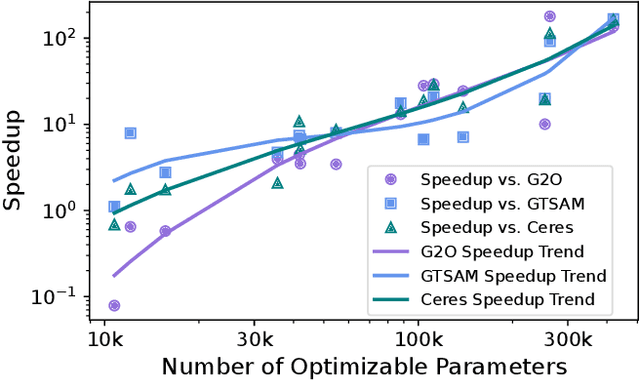

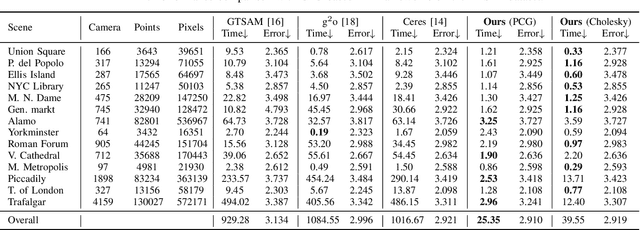
Bundle adjustment (BA) is a critical technique in various robotic applications, such as simultaneous localization and mapping (SLAM), augmented reality (AR), and photogrammetry. BA optimizes parameters such as camera poses and 3D landmarks to align them with observations. With the growing importance of deep learning in perception systems, there is an increasing need to integrate BA with deep learning frameworks for enhanced reliability and performance. However, widely-used C++-based BA frameworks, such as GTSAM, g$^2$o, and Ceres, lack native integration with modern deep learning libraries like PyTorch. This limitation affects their flexibility, adaptability, ease of debugging, and overall implementation efficiency. To address this gap, we introduce an eager-mode BA framework seamlessly integrated with PyPose, providing PyTorch-compatible interfaces with high efficiency. Our approach includes GPU-accelerated, differentiable, and sparse operations designed for 2nd-order optimization, Lie group and Lie algebra operations, and linear solvers. Our eager-mode BA on GPU demonstrates substantial runtime efficiency, achieving an average speedup of 18.5$\times$, 22$\times$, and 23$\times$ compared to GTSAM, g$^2$o, and Ceres, respectively.